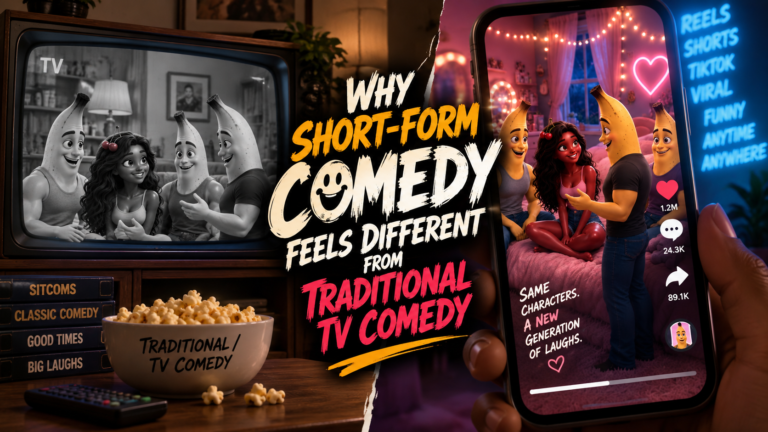
Comedy has always been about timing. A joke can be hilarious because of the punchline, the character delivering it, the situation surrounding it, or simply the three seconds of silence before somebody says something completely ridiculous.
But the way we consume comedy has changed dramatically.
A traditional television sitcom might spend 20 minutes building a story around a few major jokes. A short-form comedy video on Instagram, TikTok, YouTube Shorts, or Facebook might have only 30 seconds to make someone laugh, understand the situation, and decide whether to keep watching.
That difference has created an entirely different style of comedy.
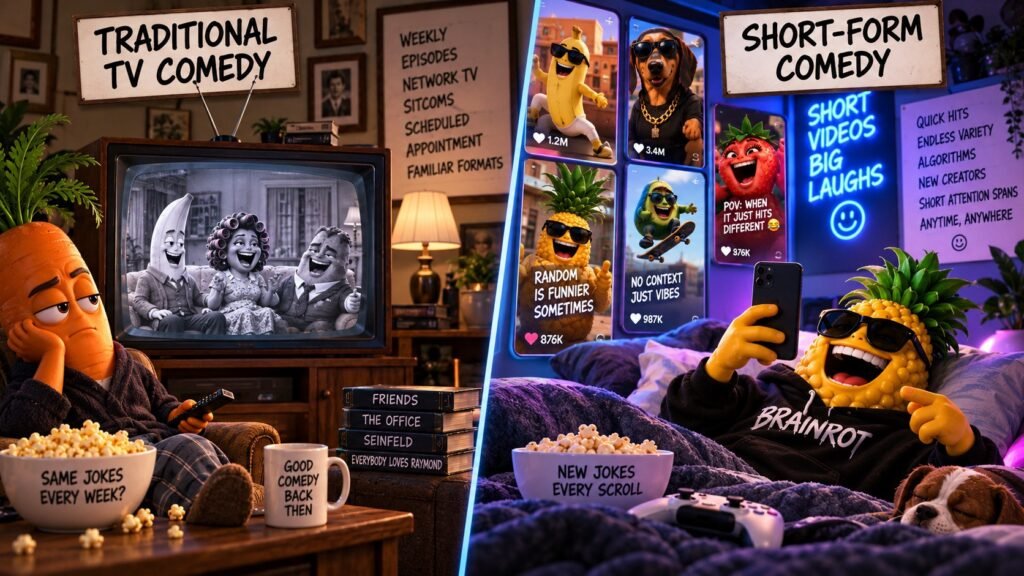
Short-form comedy isn’t simply traditional comedy squeezed into a smaller package. The format itself changes how jokes are written, performed, edited, and even understood.
The Joke Has to Start Almost Immediately
One of the biggest differences between traditional television comedy and short-form comedy is the amount of time available to establish a premise.
A sitcom can introduce its characters, establish the setting, develop a conflict, and eventually deliver the joke. Viewers have already committed to watching the episode, so the story has room to breathe.
Short-form video doesn’t have that luxury.
A creator might have only a few seconds to convince someone that the video is worth watching.
That’s why short-form comedy frequently begins with something unusual:

- A strange situation
- An unexpected statement
- A ridiculous character
- A dramatic reaction
- A question
- A mystery
- A conflict that immediately needs an explanation
Instead of spending several minutes setting up a joke, the setup itself becomes part of the entertainment.
The viewer needs to understand, at least roughly, what is happening and why they should care almost immediately.
Short-Form Comedy Relies Heavily on Visuals
Television comedy has traditionally depended heavily on dialogue.
Think about the classic sitcom setup: two characters standing in a kitchen, talking about something ordinary until one of them delivers a funny line.
Short-form video can work completely differently.
A character’s facial expression might be the joke.
A strange background detail might be the joke.
A ridiculous costume might be the joke.
Sometimes the viewer doesn’t even need dialogue to understand what’s funny.
This is especially important on platforms where people scroll through videos quickly. The visual presentation has to communicate the premise before the audience has necessarily heard every word.
That’s one reason exaggerated facial expressions, unusual characters, dramatic camera angles, captions, sound effects, and fast visual transitions have become so common in online comedy.
The screen itself becomes part of the punchline.
The Audience Is Part of the Experience
Traditional television is mostly a one-way experience.
A show airs, viewers watch it, and the conversation happens somewhere else.
Short-form comedy is different because the audience can immediately respond.
Someone can watch a video and comment:
“Why did he do that?”
Another person can respond:
“I would’ve done the same thing.”
Someone else might tag a friend because the situation reminds them of that person.
The comments can become an extension of the joke.
This creates an interesting feedback loop. Creators can see which characters people like, which jokes generate reactions, and which storylines make viewers demand another episode.
A random funny video can therefore turn into an ongoing series simply because the audience wants to know what happens next.
Short-Form Comedy Loves the Unexpected
Traditional comedy certainly uses surprise, but short-form platforms have pushed the concept even further.
A video might begin as one type of story and suddenly become something completely different.
A normal conversation becomes an argument.
A cooking video becomes a crime investigation.
A relationship story becomes a ridiculous plot twist.
A seemingly innocent character turns out to have a completely unexpected secret.
The reason this works so well is simple: people are constantly deciding whether to continue watching.
An unexpected development gives them a reason to stay.
This is also why cliffhangers can be surprisingly effective in comedy. The audience may laugh at the situation, but they also want to know what happens next.

The result is a strange hybrid of comedy and storytelling.
The Punchline Doesn’t Always Have to Be a Joke
This might be one of the biggest differences between traditional comedy and modern short-form comedy.
A punchline doesn’t necessarily have to be a clever sentence.
It can be an image.
It can be a reaction.
It can be a sudden change in music.
It can be an absurd character entering the scene.
It can be something happening in the background that the viewer wasn’t supposed to notice.
It can even be the ending itself.
For example, imagine a video that spends 20 seconds building up an extremely serious situation.
The viewer expects a dramatic conclusion.
Instead, the final shot reveals something completely ridiculous happening in the background.
There doesn’t need to be a traditional joke.
The contrast is the joke.
Editing Has Become Part of the Comedy
In television, editing generally supports the comedy.
In short-form content, editing can actually create the comedy.
A quick zoom can emphasize a facial expression.

A sudden cut can completely change the meaning of a scene.
A sound effect can turn an ordinary moment into a punchline.
A perfectly timed pause can make an otherwise mediocre joke work.
Even the speed of the cuts affects how the audience experiences the humor.
This has created a style of comedy where editors are almost performing alongside the actors or characters.
The edit isn’t simply connecting scenes.
The edit is part of the performance.
Short Videos Encourage Bigger Characters
Short-form comedy also tends to reward recognizable characters.
A viewer might not remember the entire plot of a video, but they may remember “the crazy banana guy,” “the suspicious neighbor,” or “the grandmother who keeps doing ridiculous things.”
That creates an opportunity for creators to build recurring characters.
Once an audience understands a character’s personality, the creator doesn’t have to explain everything from scratch.
The character itself becomes part of the setup.
That’s particularly useful for animated or AI-generated comedy, where creators can build entire fictional worlds around recurring characters.
A watermelon can become a businessman.
A banana can become a criminal mastermind.
A group of fruits can become an entire neighborhood.
Suddenly, the audience isn’t just watching individual jokes. They’re watching a universe.
Traditional TV Has Episodes. Social Media Has Loops.
Television is structured around episodes and seasons.
Short-form comedy is increasingly structured around loops.
A creator posts one video.
The audience wants another.
The next video references the previous one.
A new character appears.
That character gets their own story.
Eventually, several unrelated jokes become connected.
This creates a kind of informal serialized comedy.
The audience doesn’t necessarily know they’re following a “season.” They’re simply watching the next video whenever it appears in their feed.
That structure gives creators enormous flexibility.
A character doesn’t need to disappear after one joke. If people enjoy them, they can keep coming back.
The Viewer Decides What Happens Next
Perhaps the most interesting difference is that short-form comedy is constantly being shaped by its audience.
Comments can influence future stories.
Popular characters can return.
A throwaway joke can become an entire series.
A background character can unexpectedly become the star.
Creators can also experiment much more frequently than traditional television writers.
Instead of spending months producing an entire season, an online creator can test an idea today and see how people react.
If it works, they can build on it.
If it doesn’t, they can move on.
That rapid experimentation has created an enormous amount of weird, unpredictable comedy.
And frankly, some of it is spectacularly strange.
Why Short-Form Comedy Keeps Getting Weirder
The short-form format rewards originality because viewers have seen thousands of conventional jokes.
A guy telling a joke into a camera isn’t necessarily enough anymore.
Creators have increasingly turned to unusual characters, bizarre situations, surreal visuals, unexpected endings, and exaggerated storytelling to stand out.
This is part of why internet comedy can sometimes feel completely disconnected from traditional television.
The goal isn’t always to create a polished sitcom-style joke.
Sometimes the goal is simply to make someone stop scrolling and think:
“What in the world am I watching?”
Then they watch the entire thing.
Then they send it to somebody else.
Then they watch another one.
And somewhere along the way, a 25-second video has accomplished what a traditional sitcom spent an entire scene trying to accomplish: it made the viewer feel something and remember the joke.
Short-Form Comedy Isn’t Replacing Traditional Comedy
Traditional television comedy isn’t necessarily becoming obsolete.

The two formats simply operate under different rules.
Television has more time for character development, dialogue, story arcs, recurring locations, and complicated setups.
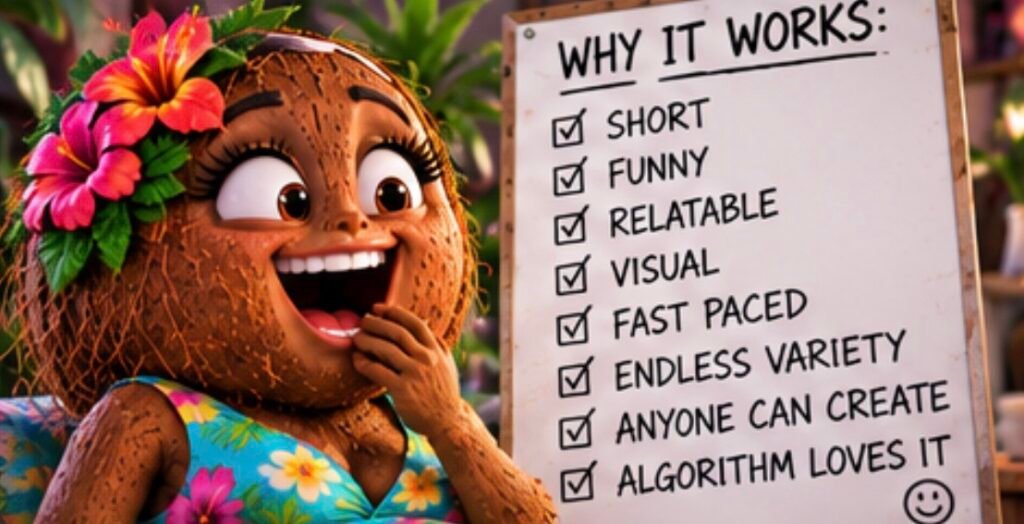
Short-form video has speed, experimentation, audience interaction, visual humor, and the ability to deliver an unexpected punchline almost instantly.
Both formats can be funny.
They’re just built for different viewing experiences.
The most interesting part is that the two worlds are beginning to overlap. Television shows increasingly use social media to promote characters and scenes, while online creators are building stories with the structure and ambition of television shows.
The difference between a “social media video” and a “miniature television episode” is becoming harder to define.
And that may be where short-form comedy gets the most interesting.
Because when creators have only a few seconds to make you laugh, they have to find increasingly creative ways to tell a story.
Sometimes that produces clever comedy.
Sometimes it produces complete nonsense.
And sometimes, somehow, the complete nonsense is the funniest part.